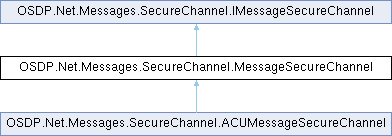
V2 implementation of a SecureChannel class. More...
Public Member Functions | |||||
| byte[] | DecodePayload (byte[] payload) | ||||
Decodes the payload using the secure channel context.This function can only be called once IsSecurityEstablished is true
| |||||
| void | EncodePayload (byte[] payload, Span< byte > destination) | ||||
Encrypts the payload using the secure channel context.This function can only be called once IsSecurityEstablished is true.
| |||||
| ReadOnlySpan< byte > | GenerateMac (ReadOnlySpan< byte > message, bool isIncoming) | ||||
Generates a new Message Authentication Code.Note this command IS NOT idempotent as every time it is called it will calculate a new rolling MAC value based on the results of the previous call
| |||||
| void | InitializeACU (byte[] clientRandomNumber, byte[] clientCryptogram) | ||||
Initializes the Access Control Unit (ACU) in the secure channel context.
| |||||
| void | ResetSecureChannelSession () | ||||
| Resets the secure channel session by creating a new random number. | |||||
| void | Establish (byte[] rmac) | ||||
Establishes the secure channel with the provided RMAC.
| |||||
| ReadOnlySpan< byte > | PadTheData (ReadOnlySpan< byte > data) | ||||
Pads the given data with padding bytes to make it a multiple of a specified length.
| |||||
Protected Member Functions | |
| MessageSecureChannel (SecurityContext context=null, ILoggerFactory loggerFactory=null) | |
| Initializes a new instance of MessageSecureChannel class. | |
| byte[] | GenerateCommandMac (ReadOnlySpan< byte > message) |
| Generates a MAC for a command message. | |
| byte[] | GenerateReplyMac (ReadOnlySpan< byte > message) |
| Generates a MAC for a reply message. | |
| byte[] | DecodePayload (byte[] payload, byte[] iv) |
| Decodes the payload. | |
| void | EncodePayload (byte[] payload, byte[] iv, Span< byte > destination) |
| Encodes the payload. | |
Properties | |
| ILogger | Logger [get] |
| Optional logger instance. | |
| SecurityContext | Context [get] |
| Security state used by the channel. | |
| bool | IsSecurityEstablished [get] |
| Indicates whether or not a secure channel has been established on the current message channel. | |
| bool | IsInitialized [get] |
Gets a value indicating whether the secure channel is initialized.true if the secure channel is initialized; otherwise, false. | |
| byte[] | ServerRandomNumber [get] |
| Represents the server random number used in the secure channel context. | |
| byte[] | ServerCryptogram [get] |
| Represents the secure channel cryptogram used by the server.This property is used to retrieve the server cryptogram for the secure channel context within which a message is packed/unpacked. | |
| bool | IsUsingDefaultKey [get] |
| Gets a value indicating whether the secure channel is using the default key. | |
Detailed Description
V2 implementation of a SecureChannel class.
With introduction of OSDP PD simulator as well as CLI tool to parse pcap files generated by this library, we had to do some refactoring. In doing so, we introduced a new Message class hierarchy based on Message -> IncomingMessage inheritance (we are yet to add OutgoingMessage but most of the logic that would go in that, is presently in OSDP.NET.Messages.PD.Reply class)
Whereas the older SecureChannel class was passed directly into Message parsing/building code, this new class hierarchy depends on IMessageChannel interface to interact with the secure channel context and this class is the base implementation for that
Definition at line 19 of file MessageSecureChannel.cs.
Constructor & Destructor Documentation
◆ MessageSecureChannel()
|
inlineprotected |
Initializes a new instance of MessageSecureChannel class.
- Parameters
-
context Optional security context state to be used by the channel. If one is not provided, new default instance of the context will be created internally. This is useful when more than one channel have a need to share the same security state (i.e. in cases of implementing a spy that analyzes traffic flow through the two inbound and outbound channels loggerFactory Optional logger factory from which a logger object for the message channel will be acquired
Definition at line 31 of file MessageSecureChannel.cs.
Member Function Documentation
◆ DecodePayload() [1/2]
|
abstract |
Decodes the payload using the secure channel context.This function can only be called once IsSecurityEstablished is true
- Parameters
-
payload Payload to be decrypted
- Returns
- Plaintext message payload. Similarly to how original payload must have been padded prior to being encrypted, the plaintext byte buffer returned here will also be padded and therefore its length will always be divisible by 16. The padding at the end of the buffer will always consist of zero or more 0x00 bytes preceeded by 0x80 byte.
Implements OSDP.Net.Messages.SecureChannel.IMessageSecureChannel.
◆ DecodePayload() [2/2]
|
inlineprotected |
Decodes the payload.
- Parameters
-
payload Cyphertext of the message payload iv crypto initialization vector
- Returns
- Message payload as plaintext
Definition at line 142 of file MessageSecureChannel.cs.
References Context, and IsSecurityEstablished.
◆ EncodePayload() [1/2]
|
inlineprotected |
Encodes the payload.
- Parameters
-
payload Message payload as plaintext iv Crypto initialization vector destination Destination where cyphertext is to be written
- Returns
- Cyphertext of the message payload
Definition at line 172 of file MessageSecureChannel.cs.
References Context, and IsSecurityEstablished.
◆ EncodePayload() [2/2]
|
abstract |
Encrypts the payload using the secure channel context.This function can only be called once IsSecurityEstablished is true.
- Parameters
-
payload Payload to be encrypted. NOTE: This data MUST already be padded in according to OSDP specification: a) there must be at least one byte of padding; b) payloaded is padded with 0x00, except for the very first byte of padding which must be 0x80; c) total length must be divisible by AES block size of 16 bytes. destination Identifies where encoded data is to written to
Implements OSDP.Net.Messages.SecureChannel.IMessageSecureChannel.
◆ Establish()
| void OSDP.Net.Messages.SecureChannel.MessageSecureChannel.Establish | ( | byte[] | rmac | ) |
Establishes the secure channel with the provided RMAC.
- Parameters
-
rmac The RMAC.
Implements OSDP.Net.Messages.SecureChannel.IMessageSecureChannel.
References Context.
◆ GenerateCommandMac()
|
protected |
Generates a MAC for a command message.
- Parameters
-
message Message bytes to generate code from
- Returns
- Newly generated MAC
- Exceptions
-
SecureChannelRequired Thrown if secure channel has not been established
References Context.
Referenced by OSDP.Net.Messages.SecureChannel.ACUMessageSecureChannel.GenerateMac().
◆ GenerateMac()
|
abstract |
Generates a new Message Authentication Code.Note this command IS NOT idempotent as every time it is called it will calculate a new rolling MAC value based on the results of the previous call
- Parameters
-
message Message to be signed with a MAC isIncoming If true, indicates that the message was received from the wire. If false, indicates that the message is being sent out on the wire
- Returns
- 16-byte MAC value of the message
Implements OSDP.Net.Messages.SecureChannel.IMessageSecureChannel.
◆ GenerateReplyMac()
|
protected |
Generates a MAC for a reply message.
- Parameters
-
message Message bytes to generate code from
- Returns
- Newly generated MAC
- Exceptions
-
SecureChannelRequired Thrown if secure channel has not been established
References Context, and IsSecurityEstablished.
◆ InitializeACU()
|
inline |
Initializes the Access Control Unit (ACU) in the secure channel context.
- Parameters
-
clientRandomNumber The client random number. clientCryptogram The client cryptogram.
Implements OSDP.Net.Messages.SecureChannel.IMessageSecureChannel.
Definition at line 72 of file MessageSecureChannel.cs.
References Context.
◆ PadTheData()
|
inline |
Pads the given data with padding bytes to make it a multiple of a specified length.
- Parameters
-
payload The payload data to pad.
- Returns
- The padded data.
Implements OSDP.Net.Messages.SecureChannel.IMessageSecureChannel.
Definition at line 195 of file MessageSecureChannel.cs.
◆ ResetSecureChannelSession()
| void OSDP.Net.Messages.SecureChannel.MessageSecureChannel.ResetSecureChannelSession | ( | ) |
Resets the secure channel session by creating a new random number.
Implements OSDP.Net.Messages.SecureChannel.IMessageSecureChannel.
References Context.
Property Documentation
◆ Context
|
getprotected |
Security state used by the channel.
Definition at line 45 of file MessageSecureChannel.cs.
Referenced by OSDP.Net.Messages.SecureChannel.ACUMessageSecureChannel.DecodePayload(), DecodePayload(), OSDP.Net.Messages.SecureChannel.ACUMessageSecureChannel.EncodePayload(), EncodePayload(), Establish(), GenerateCommandMac(), GenerateReplyMac(), InitializeACU(), MessageSecureChannel(), and ResetSecureChannelSession().
◆ IsInitialized
|
get |
Gets a value indicating whether the secure channel is initialized.true if the secure channel is initialized; otherwise, false.
Implements OSDP.Net.Messages.SecureChannel.IMessageSecureChannel.
Definition at line 51 of file MessageSecureChannel.cs.
◆ IsSecurityEstablished
|
get |
Indicates whether or not a secure channel has been established on the current message channel.
Implements OSDP.Net.Messages.SecureChannel.IMessageSecureChannel.
Definition at line 48 of file MessageSecureChannel.cs.
Referenced by DecodePayload(), EncodePayload(), and GenerateReplyMac().
◆ IsUsingDefaultKey
|
get |
Gets a value indicating whether the secure channel is using the default key.
Implements OSDP.Net.Messages.SecureChannel.IMessageSecureChannel.
Definition at line 60 of file MessageSecureChannel.cs.
◆ Logger
|
getprotected |
Optional logger instance.
Definition at line 40 of file MessageSecureChannel.cs.
Referenced by MessageSecureChannel().
◆ ServerCryptogram
|
get |
Represents the secure channel cryptogram used by the server.This property is used to retrieve the server cryptogram for the secure channel context within which a message is packed/unpacked.
Implements OSDP.Net.Messages.SecureChannel.IMessageSecureChannel.
Definition at line 57 of file MessageSecureChannel.cs.
◆ ServerRandomNumber
|
get |
Represents the server random number used in the secure channel context.
Implements OSDP.Net.Messages.SecureChannel.IMessageSecureChannel.
Definition at line 54 of file MessageSecureChannel.cs.
The documentation for this class was generated from the following file:
- OSDP.Net/Messages/SecureChannel/MessageSecureChannel.cs